
Air Canada started suspending flights on Thursday morning as a potential strike by flight attendants looms, with hundreds of flights expected to be cancelled by the end of the week.
“That includes a first set of cancellations that were processed this morning, in particular, long-haul international flights due to depart tonight,” chief operations officer Mark Nasr said during a news conference, alongside chief human resources officer Arielle Meloul-Wechsler.
The cancellations will keep going and “grow in magnitude,” Nasr said, with Air Canada expecting to cancel several dozen flights on Thursday and about 500 flights by Friday evening, affecting over 100,000 customers.
All flights will be paused by Saturday morning, with the work stoppage slated to officially start just before 1 a.m. ET that day.
Canadian travellers have been anxiously awaiting news of cancelled flights. As of 1:45 p.m. ET, the flight-tracking website FlightAware showed nine Air Canada flights departing on Thursday had been cancelled. The airline also cancelled seven flights and budget airline Air Canada Rouge cancelled three flights scheduled for Friday.
- Cross Country Checkup is asking: How will you be affected by an Air Canada strike? What should be done about it? Leave your comment here and we may read it or call you back for our show this afternoon.
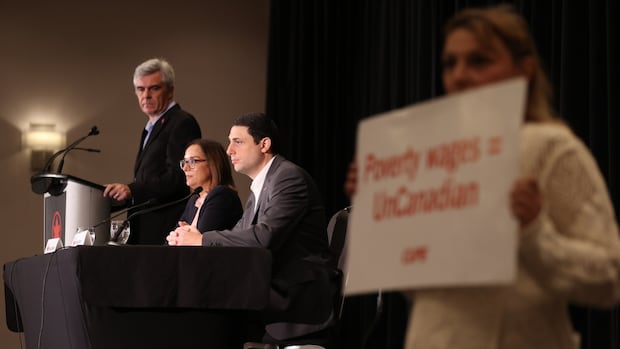
The news conference, held at the Sheraton Hotel near Toronto’s Pearson airport, was cut short by Air Canada’s chief communications officer Christophe Hennebelle after CUPE members entered the room holding up signs bearing slogans like “Unpaid work won’t fly” and “Poverty wages = UnCanadian.”
Air Canada walked away, union president says
During its own news conference on Thursday afternoon, CUPE Air Canada Component president Wesley Lesosky said that the union is trying to “end the abuse of unpaid work by this company.”
The union has often said that some of its members are struggling to pay rent and buy basic groceries.
Lesosky also criticized the federal government, saying that “every party has expressed support for our effort to end unpaid work except for the governing Liberal Party.”
Several CUPE representatives have said that Air Canada hasn’t been at the negotiating table since Tuesday evening.
“Air Canada walked away when we entertained wages, unpaid work, and very minor other detailed items. So those two big items seem to be the catalysts that has [led] them to walk away,” Lesosky said.
Air Canada officials said earlier on Thursday that the union made the last few days of negotiations “meaningless” by making “unsustainable offers.”
Air Canada asks government to intervene
Airline executives also said they have asked the federal government to intervene if a deal does not materialize, and that the airline has shared the level of disruption it anticipates with the government.
Among the sticking points in negotiations are wages and something called “ground pay,” which covers the work that flight attendants do before boarding and after deplaning, including safety procedures and assisting passengers.
Henly Larden, an Air Canada flight attendant and the vice-president of CUPE 4094, says flight attendants work an average of 35 unpaid hours per month related to duties performed during boarding and deplaning. This comes as Air Canada flight attendants rallied outside major airports on Monday as part of a national day of action to protest low pay and unpaid work.
The union says Air Canada offered an eight per cent wage increase in the first year of a four-year deal, while Air Canada said it offered the union a 38 per cent increase in total compensation (which includes wages and benefits) over four years, with a 25 per cent increase in the first year. The union maintains it hasn’t seen such an offer.
The airline proposed ground pay at 50 per cent of a flight attendant’s hourly rate, according to CUPE’s Air Canada component. The union declined the proposal and is asking for ground work to be paid at 100 per cent.

Federal Jobs Minister Patty Hajdu says she asked the Canadian Union of Public Employees to respond to Air Canada’s request for binding arbitration. Air Canada said earlier this week that it would start cancelling flights on Thursday to mitigate the impact of a potential strike that could start on Saturday just before 1 a.m. ET.
Earlier Thursday, the federal jobs minister said she asked the Canada Union of Public Employees to respond to the airline’s request for binding arbitration.
“I have met with both parties throughout the bargaining process and strongly urged them to come to an agreement,” Minister Patty Hajdu wrote on social media platform X.
“Air Canada submitted a request that I make a referral under Section 107 of the Canada Labour Code to send the parties to binding arbitration. I have asked the union to respond to the employer’s request.”
Earlier this week, Air Canada sent a proposal to CUPE that the parties use binding interest arbitration to come to an agreement as they negotiate the renewal of a 10-year collective agreement for more than 10,000 flight attendants.
CUPE declined to use arbitration, a process in which an outside arbitrator would hear proposals from each side about specific agenda items that haven’t been agreed upon and then make a decision that would bind both parties.