
PCB Board Assembly Support Industrial Automation
Increasingly, PCB assembly companies are making use of industrial automation to meet the demand for high-quality, fast-turnaround products. Automation, or using machines to perform human tasks, improves efficiency, precision, and quality while reducing waste, energy consumption, and environmental impact.
PCB fabrication is a complex process that involves many steps and requires utmost accuracy in the entire sequence. Factory automation helps by tracking the progress of the board as it moves through the assembly line. This is done by attaching a tracking device such as a barcode scanner to the circuit board and scanning it as it passes each station on the conveyor belt. This way, the production speed can be tracked and any bottlenecks in the process can be identified.
The first step in the pcb board assembly manufacturing process is to prepare the components. This includes placing the surface-mount components on the PCB and applying solder paste to it. After that, the board is inspected by an automatic optical inspection machine (AOI). The AOI uses cameras to “see” the solder connections. Different-quality solder connections reflect light differently, allowing the machine to identify them. The machine can also identify other defects, such as holes that are too big or uneven.
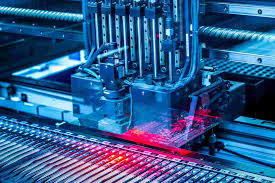
Once the AOI is finished with the board, it is ready for surface-mount technology (SMT) assembly. The robots used in this stage of the process place the SMTs on the PCB. The SMTs are attached to the solder paste with a special heat-resistant glue. The robots are then programmed to orient the components in preprogrammed locations. This allows the assembler to produce a consistent product and reduce the amount of human error in the process.
How Does PCB Board Assembly Support Industrial Automation?
After the SMT components are placed, the PCB is checked again by the AOI system and any errors that are detected are corrected. This ensures that the final product meets all of its design specifications and is ready for shipping.
Automation and robotics are revolutionizing the PCB assembly industry by improving efficiency, precision, and quality while reducing environmental impact. However, they cannot replace human expertise entirely. Skilled technicians and engineers are still needed to program, maintain, and troubleshoot automated systems. This collaborative approach between humans and machines is vital for ensuring the highest quality of production and customer satisfaction.
When choosing a CM for your next PCB project, make sure they have extensive experience, process automation in place, and a well-equipped facility to meet your specific requirements. Suntronic Inc is one such CM that can fulfill the most demanding PCB projects with their advanced manufacturing capabilities and automation. They have a track record of years of successful business partnerships and offer customized solutions to meet any need. They are a trusted partner that can help you create a world-class product with superior performance and high reliability. Contact them now to learn more about their services and to see how they can help you with your next project.
